How to Start a Private Label Hair Extension Brand: A Supplier’s Guide
Starting a private label hair extension brand can be an exciting business opportunity. Many founders see the growing demand for human hair extensions and want to build their own brand instead of selling products from existing companies.
However, building a successful hair extension brand is not only about creating a logo, choosing packaging, or ordering inventory. The biggest challenges usually appear after launch — when customers start using the products and expect consistent quality.
To start a successful private label hair extension brand, focus first on choosing the right product category, testing hair quality carefully, starting with a controlled number of SKUs, and building a reliable supply chain. Long-term success depends more on product consistency and customer satisfaction than on launching with a large inventory.

From my experience working with hair extension brands, salon owners, and distributors, the brands that grow steadily are usually not the ones that launch the largest collections. They are the ones that start with clear positioning, test products carefully, and build realistic quality standards before scaling.
Why Start a Private Label Hair Extension Brand?
People enter the hair extension industry for different reasons. However, the strongest brands usually start because the founder already sees a specific market opportunity.
A successful private label hair extension brand usually begins with a clear customer need, existing industry experience, or a unique market position — not simply the idea of selling hair products.

Existing Salon Customers Create a Strong Foundation
Many successful hair extension brands begin with salon owners or stylists.
They already understand:
- What customers expect from extension quality
- Which colors and lengths sell repeatedly
- Common complaints after installation
- What makes clients return for another purchase
This existing customer knowledge is often more valuable than simply following online trends.
A salon owner who already installs extensions every week has a clear advantage because they understand the real customer experience — from first installation to long-term wear.
Building Your Own Brand Instead of Selling Others’ Products
Many businesses eventually realize they are helping other brands build customer loyalty while remaining dependent on wholesale suppliers.
Creating a private label brand allows them to:
- Build their own reputation
- Develop customer loyalty
- Increase profit potential
- Control their product positioning
However, branding alone does not create a successful business.
I have seen companies invest heavily in packaging and marketing while ignoring product consistency. Customers may accept simple packaging in the beginning, but they rarely accept poor hair quality.
Find a Specific Opportunity Instead of Copying Competitors
The strongest brands usually solve one clear problem first.
For example:
| Market Challenge | Possible Brand Opportunity |
|---|---|
| Poor blonde extension quality | Develop more stable blonde collections |
| Thin-looking ends | Focus on stronger end fullness |
| Limited salon support | Provide professional service and education |
| Slow supplier response | Offer faster communication and development |
Trying to compete in every area from the beginning usually creates unnecessary complexity.
Start Small: The First Launch Strategy
One of the biggest mistakes new hair extension brands make is trying to launch too many products too early.
Many founders believe a large collection makes the brand look stronger. However, too many SKUs create challenges:
- Higher inventory investment
- More complicated production management
- Slower cash turnover
- More difficult market testing
For most new brands, a focused launch is usually a smarter approach than a large collection.
A practical starting strategy is:
- One product category
- 1–2 popular lengths
- 5–6 core colors
For example:
| Product Type | Lengths | Core Colors |
|---|---|---|
| Tape-in Hair Extensions | 18" and 22" | Black, Brown, Balayage, Blonde |
After collecting real customer feedback and sales data, brands can gradually expand into:
- Additional lengths
- More colors
- Other extension types
- Premium collections
Starting smaller allows brands to improve products before investing heavily.
Three Common Mistakes New Hair Extension Brands Make
Mistake 1: Judging Hair Quality Only by First Impression
Almost every hair sample looks attractive when it first arrives.
Fresh samples may feel extremely soft and smooth because of:
- Temporary finishing treatments
- Careful sample selection
- Factory preparation before shipment
However, the real quality test begins after washing and regular use.
When testing hair extensions, pay attention to:
- Tangling after washing
- Dryness at the ends
- Shedding
- Texture changes
- Heat styling performance
- Overall lifespan
A sample that feels perfect on day one does not always perform well after several weeks of use.
This is why serious brands should test samples beyond the initial unboxing experience before placing large orders.
Mistake 2: Launching Too Many SKUs Too Early
A common mistake is trying to offer every possible option immediately:
- Multiple lengths
- Dozens of colors
- Several product categories
The result is often high inventory pressure before the brand understands customer demand.
A better approach is:
Test → Collect Feedback → Improve → Expand
Successful brands usually build their product range step by step instead of trying to become a complete hair extension store overnight.
Mistake 3: Choosing Suppliers Based Only on Price
Price is important, but it should not be the only deciding factor.
Extremely low pricing usually means that something has been reduced somewhere in production.
Common cost reductions include:
- Lower hair grade
- Lower long-hair ratio
- Less end fullness
- Higher percentage of shorter hairs
- Less consistent sorting standards
The problem is that these differences may not always be obvious when receiving the first sample.
The real cost appears later through:
- Customer complaints
- Refunds
- Replacement orders
- Negative reviews
- Brand reputation damage
A lower purchase price does not always create a lower business cost.
How to Evaluate a Hair Extension Supplier
Choosing a hair extension supplier is one of the most important decisions for a new private label brand.
A supplier should not only provide attractive samples. They should be able to maintain stable quality, communicate clearly, and support your brand as your business grows.
The right supplier is not simply the one with the lowest price. It is the supplier who can consistently deliver the quality standard your customers expect.

Focus on These Key Quality Factors
When evaluating a hair extension supplier, brands should pay attention to:
1. Hair Quality
The hair should maintain good performance after washing and regular use.
Important points include:
- Softness after washing
- Natural movement
- Texture stability
- Resistance to dryness and tangling
2. End Fullness
Many buyers focus only on weight, but weight alone does not always represent the visual fullness of extensions.
The proportion of longer strands affects:
- How thick the extensions look from top to bottom
- The final appearance after installation
- Customer satisfaction
3. Color Consistency
Color is especially important for professional hair extension brands.
A reliable supplier should be able to maintain:
- Similar shades between batches
- Stable balayage and highlighted colors
- Consistent processing standards
4. Shedding and Product Durability
Different extension types have different performance requirements.
Depending on the product, brands should test:
- Weft shedding
- Tape strength
- Bond durability
- Clip quality
- Overall lifespan
A Good Sample Does Not Always Mean a Stable Bulk Order
One of the biggest mistakes new brands make is assuming that an excellent sample automatically means the supplier can provide the same quality at scale.
Sample quality and bulk production consistency are two different things.
A supplier may produce one excellent sample, but the real test is whether they can maintain:
- Same hair quality
- Same color tone
- Same fullness
- Same processing standards
across multiple production batches.
Before placing larger orders, brands should evaluate:
- Production consistency
- Quality control process
- Communication during problems
- Ability to handle repeat orders
A long-term supplier relationship depends on stability, not just one successful sample.
Why Blonde Hair Extensions Need Extra Testing
Blonde extensions are usually more challenging than darker shades because achieving lighter colors requires more chemical processing.
This can affect:
- Hair softness
- Strength
- Durability
- Long-term performance
For blonde collections, brands should pay extra attention to:
- Dryness after washing
- Tangling tendency
- Color stability
- Heat styling performance
- Hair lifespan
A supplier who produces beautiful brunette extensions may not always produce equally stable blonde extensions.
For brands planning premium blonde collections, separate testing is highly recommended.
A Supplier Should Help You Understand Trade-offs
A professional supplier should not simply answer “yes” to every request.
In human hair production, different requirements can sometimes conflict.
For example:
| Customer Requirement | Possible Challenge |
|---|---|
| Lower price | May require compromises in hair grade or fullness |
| Very light blonde | More chemical processing may affect durability |
| Maximum thickness | Higher material cost |
| Fast delivery | May limit customization options |
An experienced supplier should explain these trade-offs clearly and help brands choose realistic solutions.
The goal is not just producing what customers request. The goal is creating a product that performs well in the real market.
When Should You Invest in Private Label Packaging?
Packaging is an important part of brand identity, but it should usually come after product validation.
Many new brands invest heavily in:
- Custom boxes
- Printed bags
- Inserts
- Special packaging materials
before they fully understand their customers and products.
This can create:
- High minimum order quantities
- Excess packaging inventory
- Limited flexibility when products change
A smarter approach is to start with simple branded packaging and upgrade after sales become stable.

A Practical Early-Stage Packaging Strategy
Many new brands can start with:
- Logo stickers
- Simple branded boxes
- Product labels
- Care cards
This provides a professional brand experience without creating unnecessary inventory pressure.
Once sales volume becomes predictable, brands can invest in:
- Custom printed packaging
- Premium unboxing experience
- Retail-ready presentation
Packaging should support a successful product, not replace one.
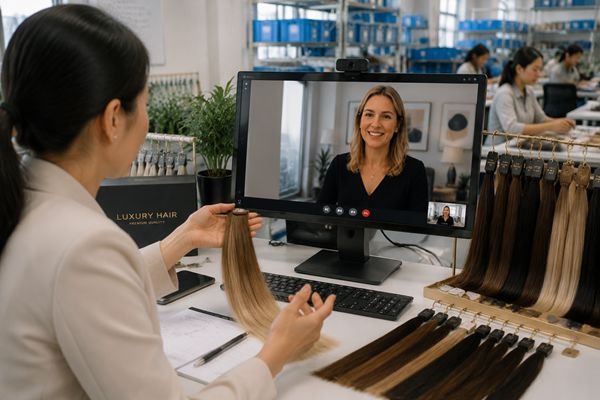
How to Choose a Long-Term Hair Extension Manufacturing Partner
As a brand grows, supplier requirements also change.
A supplier who is suitable for a first sample order may not always be the right partner for large-scale growth.
Long-term supplier partnerships are built on quality consistency, reliable communication, production capability, and problem-solving ability.
Look Beyond Production Capability
A reliable supplier should provide:
Stable Quality
The supplier should maintain consistency in:
- Hair texture
- Color
- Fullness
- Product construction
Reliable Lead Times
Production delays can affect:
- Product launches
- Salon appointments
- Customer satisfaction
- Cash flow
Problem-Solving Ability
Every manufacturing relationship will eventually face challenges.
The difference is how problems are handled.
A strong supplier should:
- Identify problems quickly
- Explain the cause clearly
- Provide practical solutions
- Improve future production
Honest Communication
The best supplier relationships are built on realistic expectations.
A supplier who explains limitations and possible risks is usually more valuable than one who promises everything without considering production reality.
Frequently Asked Questions
How much inventory should I buy for my first private label hair extension launch?
Most new brands should start with a controlled product range.
A common starting point is:
- One product category
- 1–2 lengths
- 5–6 core colors
This allows brands to test demand without creating unnecessary inventory pressure.
How do I choose a reliable hair extension supplier?
Look beyond pricing.
A reliable supplier should demonstrate:
- Stable hair quality
- Consistent production batches
- Clear communication
- Realistic recommendations
- Ability to support future growth
How long should I test hair extension samples before bulk ordering?
Avoid making decisions based only on first impressions.
Testing should include:
- Washing
- Brushing
- Heat styling
- Regular wear
Long-term performance is more important than initial softness.
Should I create custom packaging when starting my brand?
Not necessarily.
Many successful brands begin with simple branded packaging and invest in full customization after product demand becomes stable.
What is more important: lower price or better quality?
For long-term brand growth, consistent quality usually creates more value.
A slightly cheaper product that causes customer complaints can become much more expensive through refunds, replacements, and reputation damage.
Conclusion
Starting a private label hair extension brand is not about launching the largest collection or finding the cheapest supplier.
The strongest brands usually follow a more controlled approach:
Start small → Test carefully → Build quality standards → Stabilize supply chain → Expand gradually
A successful hair extension brand is built on products that customers trust and a supply chain that can support long-term growth.
Choosing the right manufacturing partner from the beginning can help avoid costly mistakes and create a stronger foundation for your brand.
Looking for a reliable private label hair extension partner? Contact Michu Hair to discuss your project and quality requirements.