When a brand or salon asks me, “What can be customized in a hair extension order?”, my answer is usually: quite a lot.
But I do not recommend customizing everything just because it is possible.
In my experience, the best custom hair extension programs are built around a few important decisions: hair quality, color, weight, construction, and packaging.
The goal is not to make every detail different.
The goal is to create a product that fits your market, works well for stylists, can be produced consistently, and is still practical to reorder.
Below are the areas I usually discuss first with brands and salon groups.
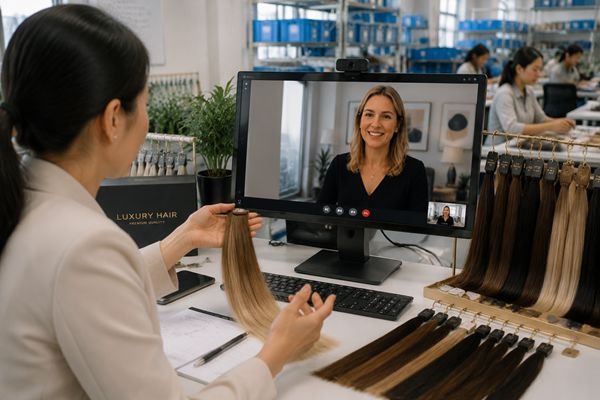
1. Length, Weight and End Fullness
These are some of the easiest specifications to customize.
| Specification | What Can Be Adjusted |
|---|---|
| Length | Standard or extra-long lengths |
| Weight | Total grams per set or piece |
| End Fullness | Fuller or lighter ends |
| Weft Width | Standard or salon-specific widths |
For clip-ins, total weight may range from around 100g to 240g or more.
For keratin or pre-bonded extensions, individual strands are usually much lighter, often around 0.6g to 1g per strand.
For wefts, both total weight and width can be adjusted according to how the salon installs the hair.
One thing I often explain is that weight and fullness are not the same thing.
Two 100g extensions can look very different if one contains a higher proportion of long strands.
This is why I look at the long-hair ratio and end fullness, not only the total grams.
Most brands only know exactly what they want after testing a sample.
A salon may tell me:
“The hair quality is right, but I want the ends fuller.”
That is normal.
Sampling is not only about checking whether the hair is good. It is also about defining the final specification.
How to Compare Hair Extension Samples from Different Suppliers
2. Hair Quality Is Selected, Not Fully Customized
This is one area that can easily become confusing.
Some clients ask whether strand thickness, softness, cuticle alignment, natural movement, or lifespan can all be customized.
Usually, these are more closely related to the raw hair quality than to product specifications.
For example, naturally medium-denier hair cannot simply be turned into ultra-fine hair through processing.
The same applies to cuticle alignment.
I consider cuticle alignment part of the hair quality standard, not an optional customization.
A brand normally chooses a hair quality level first. That decision already affects:
- Strand character
- Softness
- Wash performance
- Durability
- Long-term appearance
Silicone treatment can sometimes be adjusted to a certain degree, but it cannot change the fundamental quality of the raw hair.
So I usually separate the discussion into two questions:
What hair quality do you want?
and
What product specifications do you want?
Keeping these two decisions separate makes sampling and product development much clearer.
3. Custom Hair Colors
Color is one of the most valuable areas to customize, especially for brands building their own color collection.
There are three common ways to develop color.
Choose From an Existing Color Ring
This is usually the simplest option.
Existing colors are often easier for consistency, repeat orders, MOQ, and lead time.
For a new collection, this can be a very practical starting point.
Match a Physical Color Swatch
If a brand needs a more specific shade, I prefer working from a physical hair swatch or an approved extension sample.
We can usually develop colors such as:
- Rooted shades
- Balayage
- Highlights
- Color melts
- Dimensional blondes
- Mixed brunettes
- Custom blended shades
Use Photos Only as Direction
I do not recommend using a photo as the final production standard.
Photos are useful for showing the general direction, but lighting, screens, camera settings, and filters can all change how the color appears.
For serious custom color development, a physical reference is much safer.
Once the final shade is approved, I also recommend keeping a master sample for future production.
That gives both sides a clear reference when the same color needs to be reproduced again.

4. Product Construction
For professional salon groups and established brands, construction can be just as important as color.
This is where customization starts to affect how the product actually performs during installation.
Clip-In Extensions
Clip-ins can usually be adjusted through:
- Traditional machine-sewn craft
- Seamless PU craft
- Invisible craft
- Different widths each weft
- Clip type & quantity
- Different total weights
In most cases, I recommend choosing from existing clip type options rather than developing completely new hardware.
Unless the order volume is large, custom hardware usually adds unnecessary cost and complexity.
Tape-In Extensions
Tape-ins may be customized through:
- Regular tape-ins
- Invisible tape-ins
- Slim tape-ins
- Different tape adhensive
Some brands use the supplier's standard tape adhesive, while others may provide their preferred tape adhensive options.
Hair Wefts
Wefts offer even more options.
Depending on the product line, these may include:
- Machine weft
- Hand-tied weft
- Flat weft
- Genius weft
- Weft with holes
Weft width can also be adjusted.
For salons, this can be useful because a better width may reduce cutting and make installation more efficient.
That is the kind of customization I value most: a change that solves a real salon problem.
Keratin Tips
Keratin or pre-bonded extensions may be adjusted by:
- Strand weight
- Tip shape
- Tip size
- Keratin material
Italian keratin is commonly used for higher-end products.
The important question is not whether a specification sounds premium.
It is whether it makes sense for the installation method.

5. Private Label Packaging
Packaging can also be highly customized.
Common options include:
- Logo stickers
- Color/Length labels
- Hang tags
- Silk bags
- Boxes
- Insert cards
- Barcodes
- Custom printed sleeves
- Custom box structures
For fully custom packaging, MOQ often starts from several hundred pieces.
Around 500 pieces is a common practical starting point, although this depends on material and printing method.
For a new brand, however, I usually recommend keeping packaging simple at first.
Choose an existing packaging format and customize:
- Logo sticker
- Color/Length label
- Product information
Then upgrade later.
I have seen brands invest heavily in custom packaging before they know which colors or lengths will actually sell.
That creates unnecessary inventory and ties up cash.
Product validation should come before packaging expansion.
How to Start a Private Label Hair Extension Brand
6. What Affects MOQ, Cost and Lead Time?
Not every customization affects production in the same way.
Custom color is a good example.
Some suppliers may accept around 500g per color and length.
Personally, I often prefer around 1kg per color per length for more stable production.
A slightly larger batch usually makes it easier to control:
- Color consistency
- Processing stability
- Repeatability
- Production cost
MOQ is not always just a sales requirement.
Sometimes the batch needs to reach a certain size so the production result can be controlled more consistently.
7. The Bigger Risk Is Too Many SKUs
I do not think over-customization itself is usually the biggest problem.
The bigger issue is often too many SKUs too early.
For example:
2 products × 3 lengths × 8 colors = 48 SKUs
And that is before adding different weights, constructions, or packaging versions.
Every additional SKU means more:
- Inventory
- Cash tied up
- Reorder planning
- Warehousing
- Forecasting
- Slow-moving stock risk
This is why I often recommend keeping the first collection more focused.
It is much easier to add a successful color later than to clear a large quantity of a shade that does not sell.
8. What I Recommend Customizing First
For a new private label extension line, I usually recommend starting with:
- One product type
- One or two lengths
- Five or six core colors
- One tested hair quality
- One proven construction
- A suitable weight
- Simple branded packaging
Then test the market.
Which colors move fastest?
Which lengths reorder?
Do stylists want fuller ends?
Does the construction work efficiently during installation?
Do salons ask for a different tape, weft width, or weight?
Once those answers become clear, then it makes sense to expand into:
- Custom colors
- Additional lengths
- Different weights
- Alternative constructions
- More product categories
- Fully customized packaging
This approach may look slower, but in my experience it creates a much stronger foundation.

Customization Should Solve a Real Problem
This is the principle I come back to again and again.
Before customizing anything, ask:
What does this change improve?
Does it improve installation?
Color matching?
End fullness?
Styling?
Salon efficiency?
Brand presentation?
Customer experience?
If yes, it may be worth developing.
If the only reason is, “We want it to look different from everyone else,” then the change may simply add MOQ, cost, and complexity.
The strongest custom hair extension programs are rarely the ones with the longest specification list.
They are the ones where every decision has a clear reason behind it.
That is the difference between simply ordering a customized product and actually developing a product for a market.
Need Help Developing a Custom Hair Extension Line?
If your brand or salon is developing a private label hair extension collection, contact us to discuss the product structure, color range, MOQ, and customization priorities before bulk production.