Struggling to verify if the bulk order of hair extensions you just received matches the premium sample you approved? It's a common fear that inconsistent batches will damage your brand's reputation and lead to frustrated customers. The solution is to establish a clear, systematic testing protocol to ensure every shipment meets your standards for the quality of human hair extensions.
To test the quality of human hair extensions, you must perform a two-part inspection. First, conduct a visual check of external attributes like finished length, end fullness, weight, color accuracy, and construction quality. Second, assess the intrinsic quality by testing the hair's source, cuticle integrity, processing damage, directional alignment (tangle test), and the amount of silicone coating.
With this overview in mind, you can see that a thorough quality check goes far beyond a simple glance. These tests give you concrete data to protect your brand and your customers. Let’s explore each of these inspection points in detail so you can build your own quality control checklist.
What Are the Key Visual Checks for the Quality of Human Hair Extensions?
The visual appearance of hair extensions is your first line of defense. Obvious flaws in length, color, or construction can signal deeper, hidden issues with the manufacturing process. Ignoring these red flags can lead to a product that fails to meet customer expectations.
A proper visual inspection involves measuring against hard data points. You should check five key areas: finished length, end fullness, finished weight, color consistency, and the construction of the attachment method (e.g., the weft or bond).
Dive Deeper: A Checklist for Visual Inspection
Before you begin any inspection, you need a crucial tool: a pre-approved standard sample. Early in your relationship with a supplier, you must agree on a quality standard and keep a physical sample from that batch. All future inspections will be compared against this benchmark. Without it, quality assessment becomes subjective and difficult to enforce.
Here are the specific visual checks to perform:
: Verifying Finished Length**
This is the most straightforward test. Lay the hair extension bundle flat and straight, without stretching it. Use a measuring tape to measure from the top of the weft or bond to the very tip of the longest strands. The measured length should match the specifications on your order. For example, a 20-inch weft might have a finished length of 20.5 inches to account for final trimming, but it should never be shorter than 20 inches.
: Assessing End Fullness**
Fullness refers to the density of hair at the ends of the extension. A bundle with poor fullness will look thin and wispy at the bottom. While "full" sounds subjective, professional factories use precise methods to measure it.
You can assess fullness in two ways:
- The Touch Test: Hold your standard sample in one hand and the new bundle in the other. Close your eyes and run your hands down from root to tip. Feel the density and thickness at the ends. This gives you a quick, comparative sense of whether the new batch matches the agreed-upon fullness.
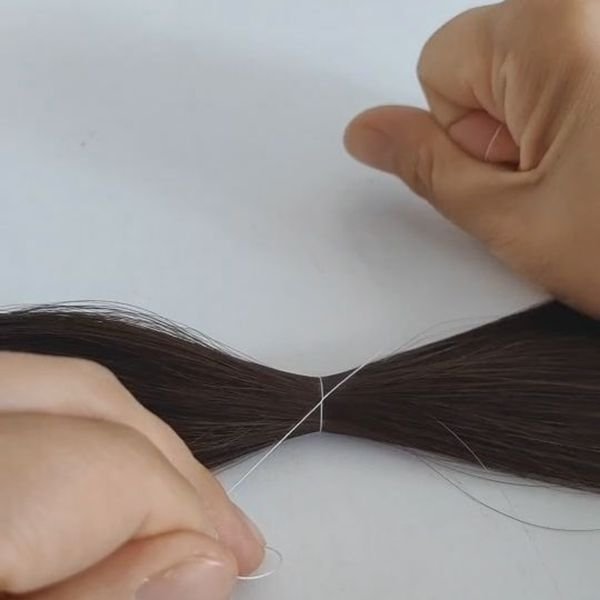
- The String Measurement Test: This is the factory-standard method and provides objective data. You will need a non-elastic string, a ruler, and a calculator.
- Step 1: Wrap the string tightly around the hair bundle at a point 3-4 inches down from the root. This position avoids any "return hair" from hand-tied wefts and gives an accurate measure of the total hair volume. Mark or cut the string and measure its length. Record this as Value A.
- Step 2: For a 20-inch extension, wrap the string tightly around the bundle at the 17.5 or 18-inch mark (i.e., 2 to 2.5 inches up from the end). Measure the length of this wrap. Record this as Value B.
- Step 3: Calculate the fullness ratio. First, divide B by A (C = B ÷ A). Then, square the result (Fullness = C²). This final number is a hard data point you can compare directly to the fullness value of your standard sample.
: Confirming Finished Weight**
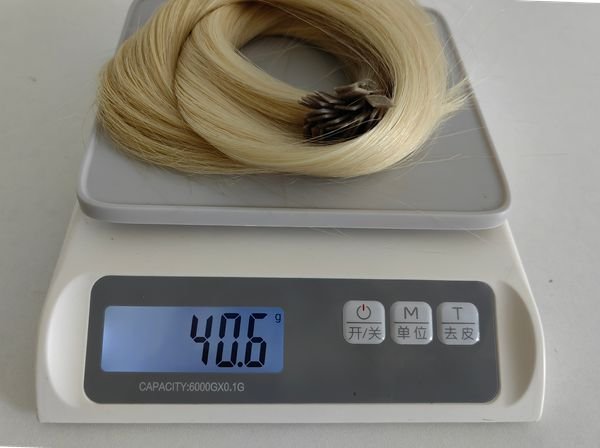
Remove all packaging, including ties, labels, and bags. Place the hair directly on a calibrated digital scale. The weight should match your order specifications (e.g., 100 grams per bundle). This simple check ensures you are not being shorted on the amount of hair you paid for.
: Checking Color Consistency**
Achieving 100% color perfection is impossible with manual dyeing processes. However, the deviation should be minimal.
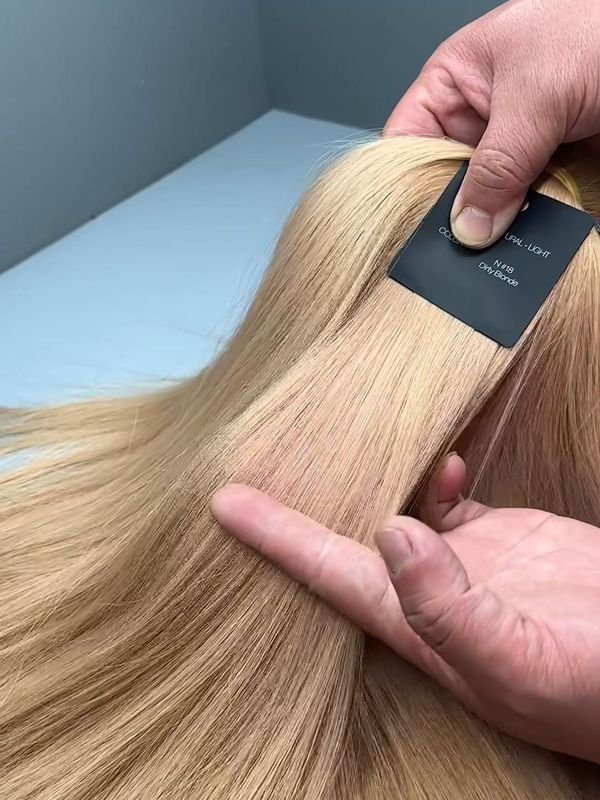
- Standard Colors: Compare the bundle to your master color ring or the pre-agreed standard color swatch. The color should be a very close match under natural light.
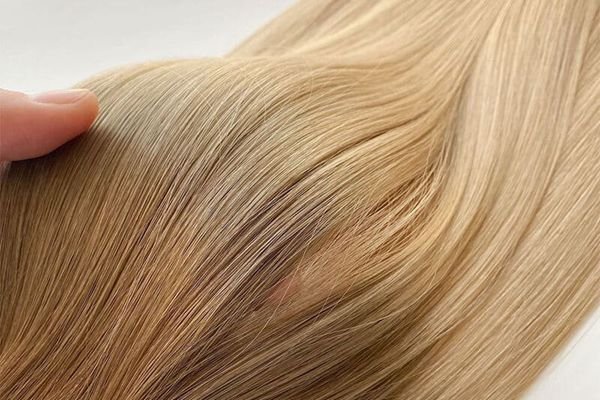
- Blended Colors: For balayage, ombre, or rooted shades, inspect the transition points. The blend should be gradual and seamless, not a harsh line. The placement of the root color and the transition zone should match the specifications of your standard sample.
: Inspecting the "Method"**
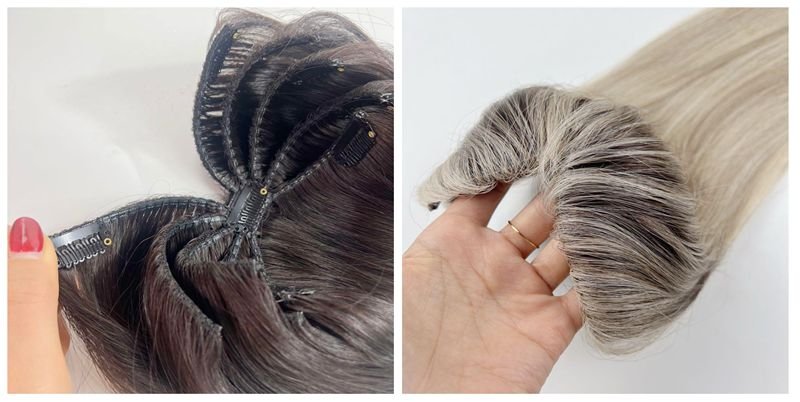
The "method" refers to the attachment point of the extension. For a weft, check its width, height, and flexibility. It should be neat, durable, and not shed excessively when you gently tug on the hair. For keratin bonds (K-tips) or tape-ins, check that the bond dimensions, texture, and color are consistent.
How Do You Test the Intrinsic Quality of Human Hair Extensions?
An extension can look perfect out of the box but become a tangled, dry mess after one wash. This happens when the beautiful exterior hides poor intrinsic quality. Relying on looks alone risks selling a product that lacks durability, leading to customer complaints and damaging your brand's credibility.
To truly understand the longevity and performance of the hair, you must conduct tests that reveal its core characteristics. These intrinsic tests for the quality of human hair extensions focus on the hair's raw material, cuticle health, and processing history.
Dive Deeper: Uncovering the Hair's True Nature
These tests help you determine if the hair will stand the test of time. Once again, every result should be compared against your standard sample.
: Identifying the Hair Source**
Human hair for extensions primarily comes from two sources:
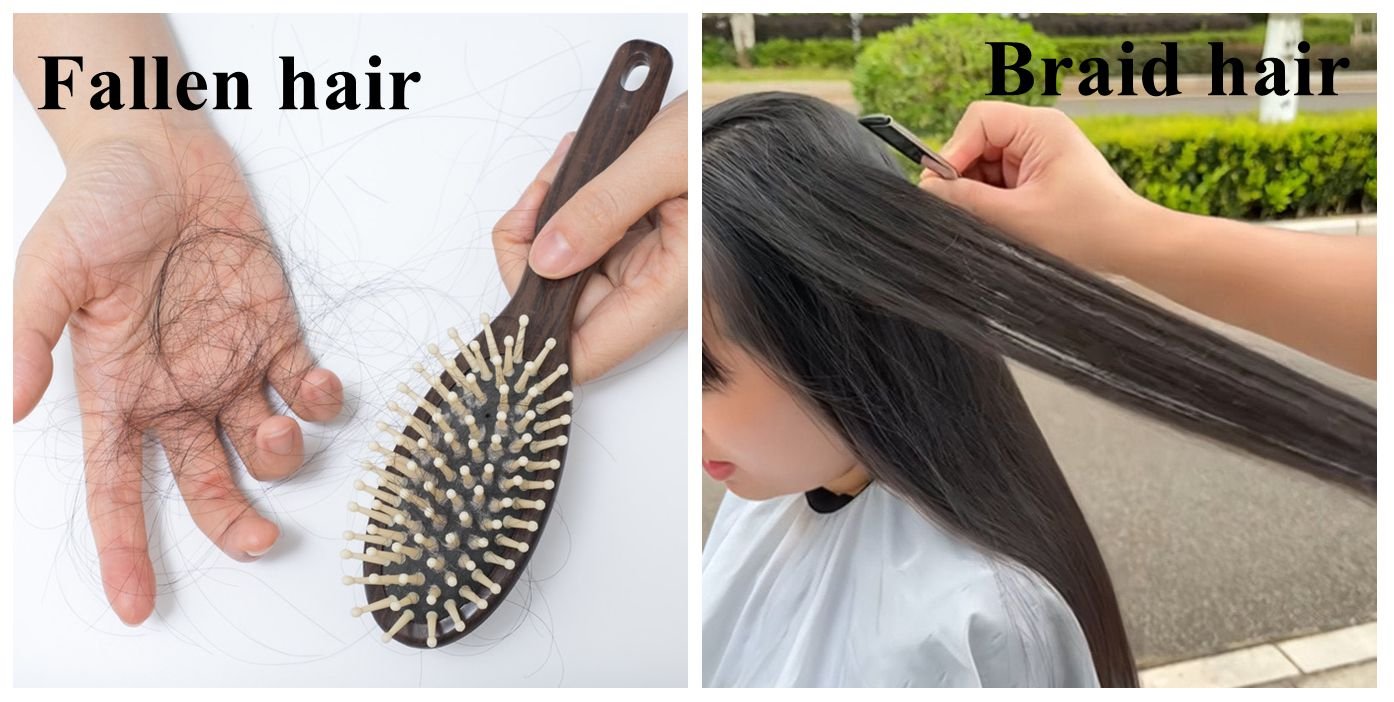
- Braid Hair: This is hair cut directly from a donor's ponytail or braid. All the cuticles are naturally aligned in the same direction (Remy). It is healthier, stronger, and more expensive.
- Fallen Hair: This is hair collected from combs, brushes, and salon floors. The cuticles are misaligned (non-Remy). To make it usable, it undergoes harsh acid processing to strip the cuticles and is then coated in silicone to prevent tangling.
- Machine-Sorted Remy: Sometimes, factories use machines to sort fallen hair so the cuticles are mostly aligned. While an improvement, it is still derived from fallen hair and is not as robust as genuine braid hair.
How to Test the Source:
-
Burn Test for Synthetics: Reputable suppliers won't intentionally mix in synthetic fibers, but it can happen with lower-grade raw materials. Pull out a few strands and carefully burn the tip with a lighter. Human hair singes and smells like burnt hair. Synthetic fibers melt into a plastic ball and produce a chemical smell.
-
Feel & Appearance: Braid hair feels resilient and strong. Over-processed fallen hair often feels unnaturally soft, light, and "fluffy" because its cuticle layer has been stripped away.
: Checking Cuticle Integrity (The Friction Test)**
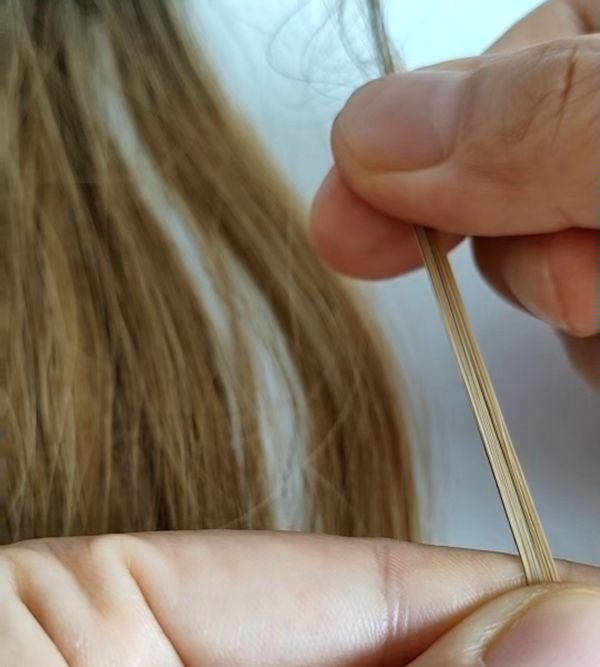
For Remy hair made from braid hair, retaining the cuticle is key to its longevity. The cuticle layer protects the hair and prevents tangling.
-
Microscope Method: The most precise way to check cuticle retention is to view a strand under a microscope. You can clearly see if the cuticle scales are intact, damaged, or completely stripped.
-
The Friction Test: This is a simple, effective method you can do anywhere. Lightly dampen your fingers or the hair strands (water helps the cuticles swell and makes the test easier).
- Pinch 5-10 strands of hair between your thumb and forefinger near the tips.
- Slide your fingers upwards toward the root. You should feel noticeable resistance or friction. This is the feeling of your fingers rubbing against the "grain" of the raised cuticle scales. More resistance = more intact cuticles.
- Now, slide your fingers downwards from root to tip. It should feel very smooth and slick. A significant difference in friction between the two directions indicates that the cuticles are present and aligned.
: Assessing Over-Processing Damage**
Chemicals used for bleaching and coloring can easily damage hair if not handled by experts.
- Stretch Test: Take a single strand of hair and pull it gently from both ends. Healthy hair has elasticity and will stretch slightly before breaking.[^1] Over-processed hair will have lost its internal structure and will snap with very little tension.
- Shine Test: Observe a single strand under a bright light. If you see sections that are intensely shiny or glittery, it's often a sign of cuticle damage.[^2] As a stylist, I've seen this happen in the salon when bleach has been left on for too long—the hair shaft begins to break down and reflects light unnaturally. This damage leads directly to dryness, frizz, and breakage for the end user.
: Performing the Tangle Test**
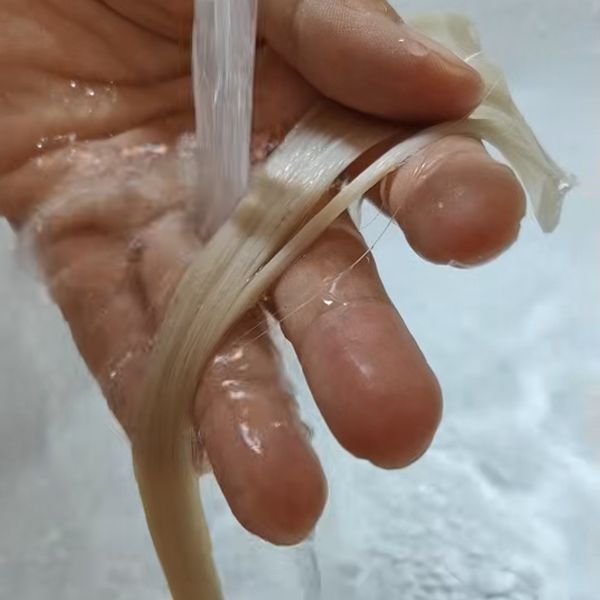
This is the ultimate test for cuticle alignment (Remy vs. non-Remy). If hair with mixed cuticle directions gets wet, the opposing cuticle scales hook onto each other and cause severe tangling. To test this, simply wash the hair bundle with shampoo, gently rub it, and rinse. If the hair immediately mats and tangles into knots that are difficult to comb through, it's a clear sign that the hair is not truly Remy and the cuticles are not aligned.
: Evaluating the Silicone Level**
Silicone provides an initial beautiful appearance, but it can also be used to mask low-quality, damaged hair.
- Feel Test: Extremely slippery, almost "wet" feeling hair often has a very heavy silicone coating.
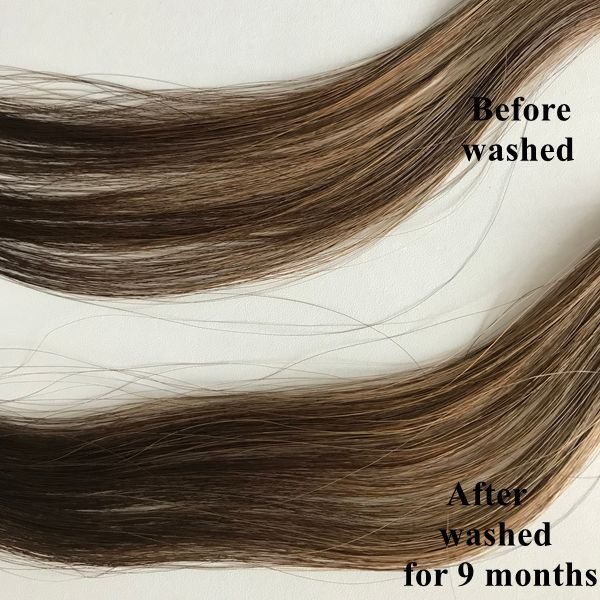
- The Wash Test: This is the most revealing test. The initial look of an extension is not the final word on its quality. Wash the hair thoroughly with a clarifying shampoo to remove all product and silicone, and then let it air dry without using any conditioner. High-quality hair will still feel healthy, retain some natural body, and look vibrant. Poor-quality hair, stripped of its silicone mask, will reveal its true self: dull, frizzy, brittle, and lifeless.[^3]
Frequently Asked Questions
Why is a standard sample so important when testing hair extensions?
A standard sample, acts as your objective benchmark. It is a physical embodiment of the quality agreement between you and your supplier. Without it, assessments of color, fullness, and feel are subjective. With it, you can make direct, side-by-side comparisons and have concrete proof if a batch does not meet the agreed-upon standards.
How can I tell if hair extensions are truly 100% Remy?
The best test is the friction and wash test. First, perform the friction test by running your fingers up the hair shaft; you should feel resistance. Then, wash the hair. True Remy hair with aligned cuticles will remain relatively smooth and manageable when wet. Non-Remy or mixed-cuticle hair will tangle and mat severely upon washing.
Can I test for synthetic fibers in human hair extensions?
Yes, the burn test is the most reliable method. Carefully burn a few strands with a lighter. Real human hair will singe, turn to ash, and produce a distinct burnt-hair smell. Synthetic fibers will melt into a hard plastic bead and emit a chemical or plastic odor.
What does "over-processed" hair look and feel like?
Over-processed hair often snaps easily when stretched (low elasticity). It may also have an unnatural, glittery shine from cuticle damage. After washing away any silicone, it will feel extremely dry, brittle, and frizzy, lacking the natural resilience and softness of healthy, minimally processed hair.
Conclusion
Systematically testing the quality of human hair extensions is not about distrust; it's about brand protection and consistency. By implementing a two-part process—covering both visual and intrinsic characteristics—you move from subjective guesswork to objective data. Remember to always compare your findings against a pre-agreed standard sample, as this is the foundation of effective quality control. Mastering these checks, from the simple weight measurement to the revealing wash test, empowers you to guarantee that every product you sell truly represents the premium standard your clients expect.
As a manufacturer dedicated to transparent, high-end quality, we work with our partners to establish these standards from day one. If you're looking for a reliable OEM/ODM supplier who values quality as much as you do, contact us to discuss your brand's needs.
[^1]: "Structure and mechanical behavior of human hair", https://pubmed.ncbi.nlm.nih.gov/28183593/. Scientific studies on the biomechanical properties of hair demonstrate that healthy hair can stretch to a certain percentage of its length before breaking. These studies also show that chemical treatments like bleaching degrade the internal protein structure (cortex), reducing its elasticity and causing it to fracture under less tension. Evidence role: statistic; source type: paper. Supports: The claim that chemical processing reduces the elasticity and tensile strength of hair.. [^2]: "What Is a Hair Cuticle & How To Seal It", https://www.lorealparisusa.com/beauty-magazine/hair-care/damaged-hair/what-is-hair-cuticle. Research in cosmetology or trichology may describe the visual signs of hair damage, explaining that as the cuticle layer lifts and breaks irregularly, it can cause light to scatter in a way that appears as an uneven or 'glittery' shine, distinct from the uniform sheen of a healthy, smooth cuticle. Evidence role: general_support; source type: research. Supports: The claim that a specific type of unnatural shine can indicate hair damage.. Scope note: The term 'glittery' is subjective, and scientific sources may use more technical descriptions for this optical effect. [^3]: "All About Silicones in Hair Products", https://olaplex.com/blogs/news/silicones-in-hair-products. Cosmetic science literature explains that silicones, such as dimethicone, form a smooth, hydrophobic film on the hair shaft, which reduces frizz and increases shine. This can mask underlying damage like a raised or broken cuticle. Clarifying shampoos contain stronger surfactants designed to strip away this type of product buildup, exposing the hair's natural, unaltered state. Evidence role: mechanism; source type: research. Supports: The claim that silicones provide a cosmetic coating on hair that can be removed with a clarifying shampoo, revealing the underlying condition of the hair shaft..